The Trap Everyone Saw Coming: Except Trump
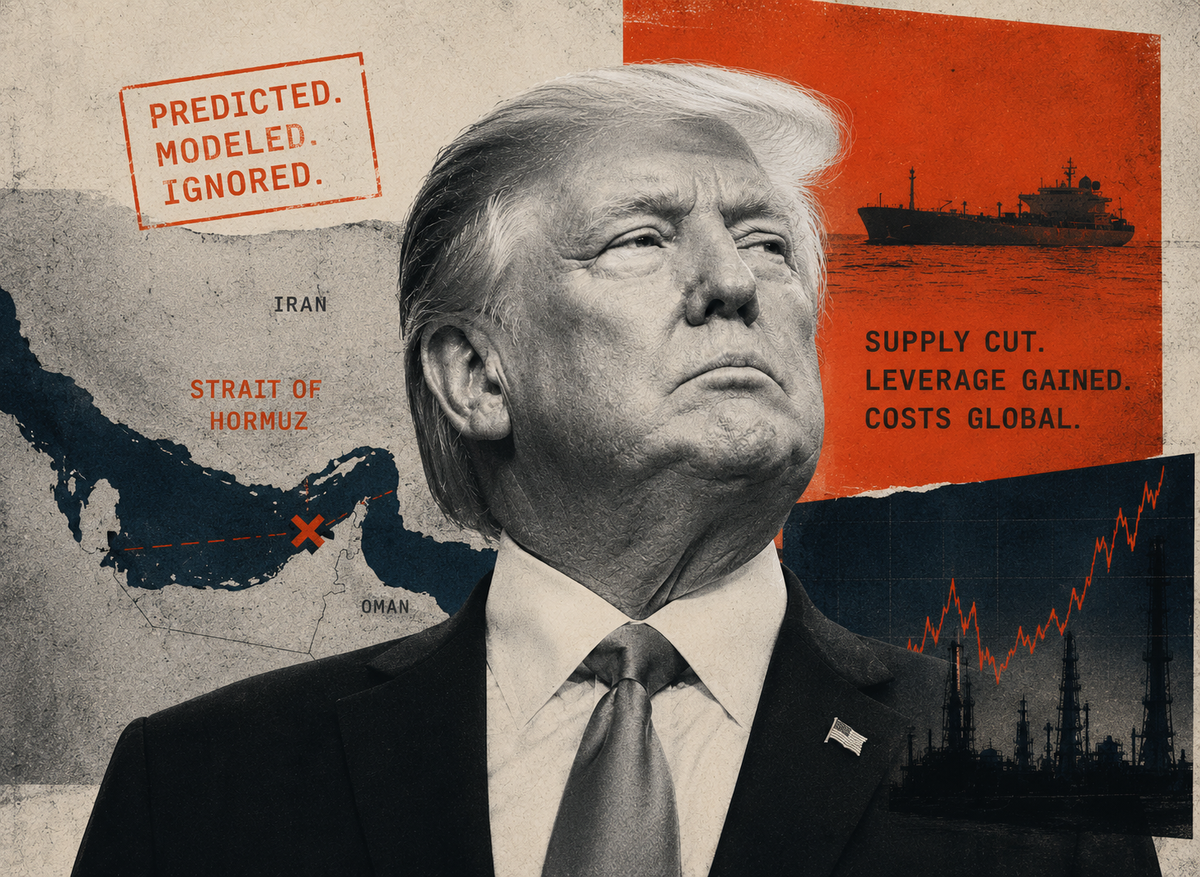
Washington didn't stumble into the Hormuz crisis. It was forced there by a president who refused to listen — and made sure nobody around him could make him.
The closure of the Strait of Hormuz was not a surprise to anyone who had been paying attention. War game planners at the Pentagon have modeled this scenario for decades. Intelligence analysts have briefed it repeatedly. Gulf security professionals have built entire contingency frameworks around it. The question was never whether Iran could close Hormuz. The question was always when — and under what conditions it would become worth the cost.
Those conditions arrived on Trump's watch. Not by accident.
The intelligence community has known for years that maximum pressure on Iran without a credible military deterrent or a viable diplomatic off-ramp carried a specific risk. Push hard enough and long enough, and Tehran would eventually conclude that the cost of inaction exceeded the cost of escalation. Hormuz was always the card at the bottom of the deck — the move Iran held in reserve for precisely the moment when American credibility was sufficiently degraded to make playing it viable.
Analysts said so. Repeatedly. In classified briefings, in think tank reports, in congressional testimony. The information existed. The planning existed. The warnings existed.
What didn't exist was anyone in the room willing to deliver them honestly.
This is where the two Trump terms diverge — and the divergence matters enormously.
During his first term, Trump was surrounded by a mix of loyalists and institutionalists. James Mattis at Defense. H.R. McMaster and then John Bolton at National Security. Rex Tillerson at State. Whatever their individual failures, these were people with independent standing, institutional knowledge, and a willingness — sometimes a compulsion — to push back. They slow-rolled decisions. They inserted friction into the process. They kept the national security apparatus functioning even when the president was pulling in a different direction.
One by one, they were fired, resigned, or forced out. Each departure was celebrated by Trump's base as a purge of the "deep state." Each departure was, in reality, the removal of another circuit breaker from a system that depends on circuit breakers to function.
The second term completed what the first term began.
The people now occupying the senior positions of the American national security apparatus were selected for a single overriding criterion: loyalty. Not competence. Not experience. Not the willingness to deliver uncomfortable assessments. Loyalty.
The result is an inner circle that has optimized itself for agreement — a closed feedback loop in which the president's instincts are validated rather than stress-tested, his assumptions confirmed rather than challenged, his blind spots protected rather than illuminated.
Every functional national security system is built on the assumption that the person at the top will sometimes be wrong. The entire apparatus — the intelligence community, the Joint Chiefs, the National Security Council — exists in part to catch those moments before they become crises. It is institutionalized disagreement. Structured friction. The system assumes fallibility and builds in correction.
Trump has spent eight years dismantling that correction mechanism. The Hormuz crisis is what the system looks like without it.
The intelligence community had done its work. The contingency plans existed. The red lines were mapped. The scenarios were modeled. By his own admission, Trump was surprised when Iran moved against Gulf shipping and closed the strait. Surprised. By the most predictable Iranian countermove in forty years of Middle Eastern geopolitics.
That is not an intelligence failure. It is a delivery failure — the failure that occurs when accurate information cannot survive the journey from analyst to decision-maker because the decision-maker has built a court, not a cabinet.
Now the options are all bad and the room contains nobody willing to say so plainly.
Military intervention contradicts Trump's core political identity. He was elected in part on a promise to end Middle Eastern entanglements, not start new ones. Ordering strikes to reopen a shipping lane for global oil markets is not a message that survives a campaign rally or a midterm cycle.
Negotiation means conceding that maximum pressure failed — that years of sanctions, isolation, and rhetorical escalation produced not capitulation but a more dangerous Iran willing to strike at the global economy directly. Every concession extracted by Tehran validates the strategy of holding firm against Washington.
Doing nothing means oil at $150, $175, possibly $200. Inflation returns. The economic record Trump treats as his primary claim to legitimacy absorbs a shock no amount of messaging can paper over.
There is no clean exit. There is only damage management — and the bitter arithmetic of how much of it could have been avoided.
The professionals whose job it is to anticipate exactly this scenario had done their work. What the system could not survive was a decision-maker who treated expert warning as disloyalty, institutional knowledge as an obstacle, and disagreement as betrayal.
The world is not in a trap nobody planned for. It is in a trap every serious analyst, strategist, and intelligence professional planned for in detail. Donald Trump was not among them.