
The Invasion That Doesn't Need to Happen
Western analysts are asking the wrong question. China doesn't need to invade Taiwan. The absorption is already underway.
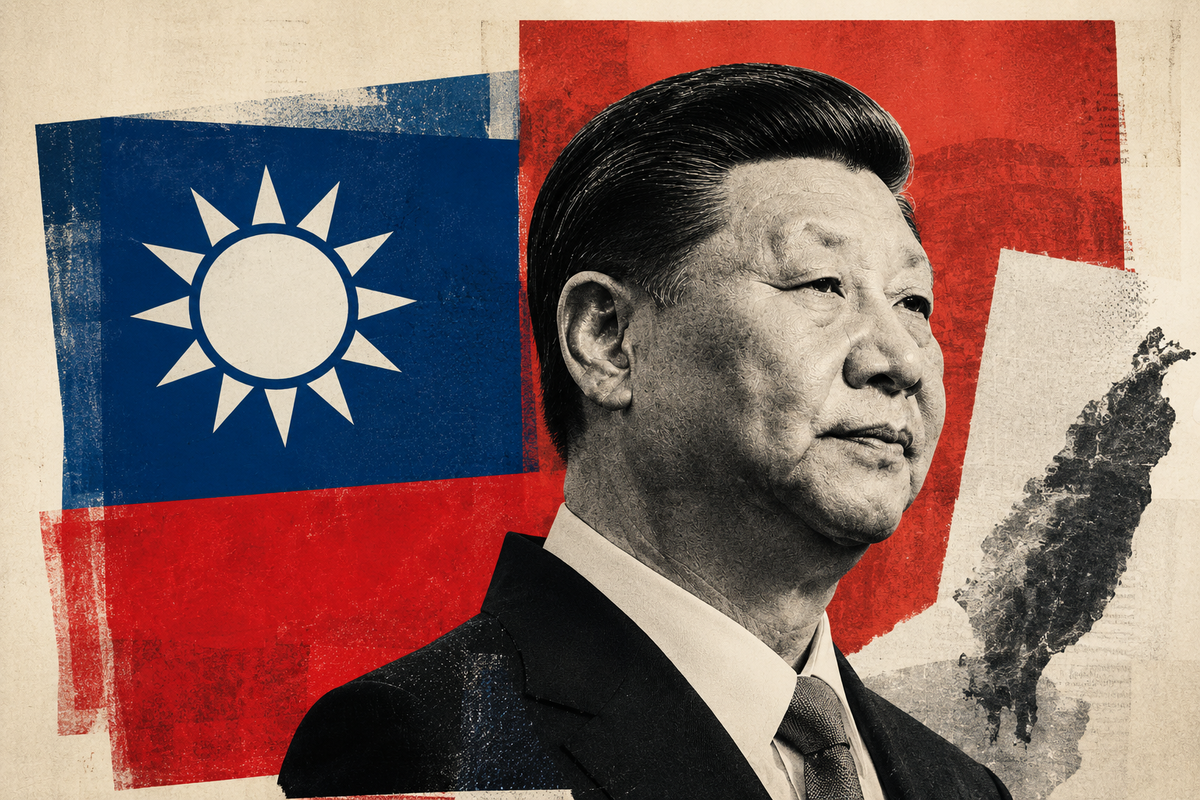
The assumption embedded in most Western analysis is that Beijing's objective culminates in amphibious landings, missile strikes, and a formal act of war. Entire defense doctrines now orbit this premise. War games simulate beachheads near Taoyuan. Analysts debate whether the PLA could sustain a cross-strait logistics operation under American interdiction. Financial markets react to every naval exercise as if a countdown has already begun.
But invasion is the most expensive option available to Xi Jinping. It carries immense uncertainty. Even a successful operation would devastate Chinese exports, fracture capital flows, trigger sanctions, and potentially destabilize the Communist Party itself. Taiwan's geography favors defenders. Urban warfare would be catastrophic. Semiconductor infrastructure could be destroyed in the process. Beijing understands all of this.
The more important question is whether China still needs to invade at all.
The architecture for a different outcome already exists.
Taiwan's economy remains deeply entangled with the mainland despite years of political tension. China and Hong Kong still account for a substantial share of Taiwan's exports and investment exposure. Entire industrial networks depend on cross-strait manufacturing relationships built over decades. Taiwanese business elites operate inside China at scale. Their incentives are not ideological. They are financial, logistical, and increasingly generational.
That dependency creates quiet pressure points. Not dramatic ones. Beijing rarely needs overt coercion when market access alone can shape behavior. Companies self-censor. Media groups moderate criticism. Political actors learn which positions preserve stability and which create economic pain. Influence becomes ambient rather than explicit.
This is the part many outside observers misunderstand. Absorption does not require ideological conversion across the Taiwanese population. It only requires enough institutional fatigue, enough elite accommodation, and enough economic inevitability that resistance gradually narrows into symbolism.
The diplomatic campaign follows the same logic. Taiwan's formal recognition network continues to shrink year by year as smaller states shift ties toward Beijing — Honduras in 2023, Nauru in 2024, each departure reinforcing the same underlying message. The practical effect is psychological as much as geopolitical. Isolation creates the appearance of inevitability. Over time, inevitability becomes a political weapon in itself.
Information operations reinforce the same frame. Chinese state media, aligned influencers, business proxies, and online networks consistently push a single underlying message: reunification is not a possibility but a historical certainty. The objective is not persuasion in the traditional sense. It is exhaustion. Convince enough people that resistance is temporary and the political center slowly adjusts around that assumption.
Taiwan remains democratic, vibrant, and distinct from the mainland. But systems do not fail all at once. They soften incrementally. Institutions adapt before populations consciously recognize that adaptation is happening.
TSMC is the single greatest reason Taiwan retains outsized strategic importance. As long as the island remains indispensable to advanced semiconductor production, the United States and its allies have overwhelming incentives to preserve the status quo. Taiwan's position as the irreplaceable node in global chip supply chains is real — and Beijing has always known it.
Yet that position is slowly being distributed outward.
New fabrication facilities in Arizona, Japan, and Germany are not replacements for Taiwan's ecosystem. They are partial redundancies. Insurance policies. Washington understands the danger of concentrating advanced chip production within missile range of the Chinese mainland. Tokyo understands it too. So does Berlin.
Paradoxically, this may increase short-term instability rather than reduce it.
If Beijing believes Taiwan's strategic leverage peaks now and gradually declines over the next decade, then the current period becomes unusually sensitive. The calculus changes when time no longer clearly favors patience. A Taiwan protected indefinitely by semiconductor indispensability is one thing. A Taiwan slowly becoming less irreplaceable is another.
This does not automatically point toward invasion. It does, however, compress strategic timelines.
Western governments continue preparing primarily for a kinetic scenario while underestimating the effectiveness of prolonged systemic pressure. Defense budgets rise. Naval deployments increase. New missile packages are announced. Yet slow integration can achieve outcomes military escalation cannot. An invasion would unite Taiwan internally, likely solidify anti-China coalitions globally, and trigger economic consequences that could damage Beijing for years. Quiet absorption avoids many of those costs.
The broader implication extends beyond Taiwan itself. A successful non-kinetic reunification strategy would alter assumptions across the international system. It would demonstrate that major territorial objectives can be achieved through economic gravity, information shaping, institutional penetration, and calibrated coercion rather than open war. Other powers would study that model carefully.
Markets already price this ambiguity in, quietly and continuously. Supply chains are diversifying but not exiting China entirely. Multinational firms publicly discuss resilience while privately preserving exposure. Semiconductor clients hedge geographically. Insurance costs shift in ways that rarely make headlines. Capital rarely waits for certainty before repositioning — and right now it is repositioning slowly, steadily, and without drama.
The signals worth watching are narrower than most headlines suggest. Massive military exercises matter less than structural changes in Beijing's posture.
A sustained Chinese effort to impose partial maritime inspections around Taiwan would be significant. So would evidence that Beijing believes Washington lacks political appetite for prolonged regional escalation. Accelerated capital controls, emergency food and energy stockpiling inside China, or rapid civilian-to-military logistics integration would matter more than another round of fighter jet incursions across the median line.
Most important is the political atmosphere inside Taiwan itself. If public confidence in indefinite autonomy begins to erode among business leaders, younger voters, or major institutions, the strategic picture changes quickly. Systems often cross thresholds quietly before they break visibly.
None of this is inevitable. Describing a strategy is not endorsing it. Taiwan is a functioning democracy of 23 million people with a distinct identity, institutions, and a legitimate claim to determine its own future. The point here is not that absorption is desirable or just — it is that the mechanisms enabling it are already operating, largely beneath the threshold of Western attention. Understanding the process is the first step toward disrupting it.
History tends to imagine conquest as an event. Increasingly, it behaves more like a process.
SAPIENT | Signal. Not noise. | sapient.news